
Oracle Health (Cerner) EHR integration: revenue cycle teams that run natively in Millennium.
_nopad_black-anim.svg)
Oracle Health EHR integration from Vee Healthtek means the work happens in Millennium, not around it. Your Oracle Health build is the system of record for how work moves - worklists, claim edits, routing rules, audit trails. Our certified front-, mid-, and back-office teams deliver inside it: your workflows, your security model, your reporting, with RevAmp analytics alongside. No swivel-chair operations, no shadow systems, no rip-and-replace.
7 of top 20
U.S. health systems served
32M+
Coding charts processed annually
28M+
A/R claims managed annually
Millennium is your system of record. Your Oracle Health EHR integration partner should work in it, not around it.
Exporting work out of Millennium creates copies, re-keying, version drift, and reconciliation overhead - and it moves activity outside your audit trail. Native delivery keeps every touch where it belongs: defects are fixed in the queue where they occur, status and notes stay in the account, and your security model governs everything our teams do.
No swivel-chair operations or shadow systems
Your security model, your audit trail, your control
Faster ramp with Cerner-experienced practitioners
Oracle Health revenue cycle services we run inside your build.
Support is organized around Millennium's own module families and worklists, so our practitioners work the same views, edits, and routing rules your teams do - front office through cash.
Front office in Scheduling and Registration workflows
Eligibility and Benefits Verification, Prior Authorization statusing, Registration QA and Demographic Accuracy, and Financial Clearance and Counseling - worked in referral and authorization worklists so encounters start billable instead of becoming downstream denials.
Back office in Millennium Patient Accounting and RevElate
Claims Administration edit worklists, follow-up worklists, Denials Management and Appeals, and Underpayment Recovery and Payer Variance Resolution - worked to your routing rules and SLAs, with status, notes, and next actions living in the account.
Mid office in Cerner HIM and coding worklists
Medical Coding, Coding Audits and Quality Assurance, Clinical Documentation Integrity (CDI), and Charge Capture Optimization - delivered in coding and deficiency worklists, account queues, and charge review, alongside your encoder and any computer-assisted coding in the build.
Cash, reconciliation, and clean closure
Payment Posting and Reconciliation, Credit Balance Review, and remittance exception handling - 835 and 837 fluency applied inside remittance and credit worklists so cash closes cleanly and variances surface early.
How Oracle Health EHR integration works: four steps, no rip-and-replace.
This is a service-led Millennium integration, not a software project. There is nothing to install in Millennium, no interfaces to build before value starts, and nothing that moves your data outside your control.
Access and security provisioning
You provision Millennium access on least-privilege role templates you control, delivered over your VPN or virtual desktop. Our controls are certified - SOC 2 Type II with HITRUST, ISO 27001:2013, HIPAA - and every action our teams take lives in your audit logging.
Production, quality, and governance
Daily work allocation, two-tier quality audits, error trending, and closed-loop corrective action - all performed on Millennium activity, with a named engagement lead accountable for the outcomes, not just the output.
Workflow and work-queue alignment
We map the queues, edits, routing rules, and SLAs that define the work, then document playbooks per queue in your terminology - calibrated with your leads before production begins, so nothing about how work moves is a surprise.
Analytics alongside, not instead
RevAmp consumes what Millennium already emits - extracts, reporting views, standard files and feeds - to prioritize work and report performance. Millennium remains the system of record; the numbers reconcile with your own reporting.
One operating model. Three pillars. Every engagement.
Expertise-led
Cerner-experienced specialists who work your worklists daily - not a pooled task team learning your build on your time.
- Certified coders, A/R specialists, authorization teams, and access practitioners aligned to your work queues
- A named engagement lead who connects queue-level work to revenue impact
- Calibration to your build - routing rules, edit logic, documentation conventions, and payer behavior
Technology-powered
RevAmp intelligence layered alongside Millennium, so the highest-value work is visible and worked first.
- Rules-driven prioritization across coding, claim edit, follow-up, and denial queues
- Dashboards that join productivity, quality, denial trends, and cash outcomes on one definition
- Automation that reduces manual touches while preserving practitioner judgment
Operationally-governed
Accountability with cadence, evidence, and ownership - not static reports after the month closes.
- Governance reviews on an agreed cadence, with KPIs defined the way your leadership measures them
- Two-tier quality audits that hold every queue to one documented standard
- Closed-loop corrective action, so a defect fixed once is fixed everywhere it occurs
Our Vision
Open accountability: taking responsibility without taking control.
Working inside your Millennium environment should not require leaders to give up control of system governance, security policy, work-queue design, coding and billing standards, or compliance priorities. You keep visibility into queue movement, practitioner actions, QA findings, defect trends, and production priorities. The service owns the outcomes it commits to through modular support, co-managed operations, or end-to-end execution, with transparent reporting built around the metrics that determine speed, accuracy, adoption, and audit confidence.
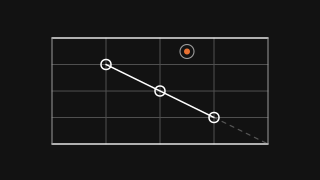
Queue throughput
Accounts and charts moved per practitioner, tracked daily
First-pass quality
Accuracy validated by two-tier QA before rework can spread
Turnaround and aging
Queue latency and aged inventory visibly reduced
Exception visibility
Routing, holds, and escalations trended, not buried
Defect recurrence
Repeat issues closed at root cause through CAPA
SECURITY AND STANDARDS
Compliance is the floor. Auditability is the standard.
Access to your Oracle Health environment is provisioned by you, governed by your role templates, and visible in your audit trail. Around it, our delivery organization operates under independently certified controls - and speaks the data standards your revenue cycle runs on.
SOC 2 Type II + HITRUST
Independently examined security and privacy controls
ISO 27001:2013
Certified information security management
HIPAA
Compliance built into every workflow and handoff
HL7 and FHIR-aware
Workflows aligned to the exchange standards Millennium speaks
X12 835 / 837 fluency
Claims and remittance handled in the payer's native grammar
Why Us
What sets our Oracle Health (Cerner) EHR integration approach apart.
Cerner EHR-native delivery breaks down when work leaves the system, access multiplies data copies, exceptions age without routing, and quality findings reach audits or denials too late. The model turns export-driven rework into first-pass performance by making queue movement, practitioner decisions, exceptions, and learning loops visible earlier.
Rework-Powered Cleanup Machine
Our First-Pass Performance
Where the work happens
Accounts are exported, worked in vendor systems, and re-keyed back after the fact.
Work queues are worked in place - status, notes, and routing stay in the account.
Access and security
Data copies multiply outside your audit trail and security model.
Client-provisioned access under your role templates, your VPN or VDI, your audit logging.
Quality visibility
QA happens on spreadsheets, sampled after defects have already shipped.
Two-tier QA runs on Millennium activity, with error trending and closed-loop correction.
Exception handling
Complex, ambiguous, or aged accounts sit in coder and biller queues without clear routing.
Exceptions route by value, complexity, payer behavior, and timely-filing impact.
Capacity use
Internal teams absorb backlog, QA, and tool upkeep while volume keeps growing.
Practitioner capacity handles defined queues while governance tracks speed, accuracy, and defects.
Extend performance across connected outcomes.
Revenue cycle thinking for leaders who need fewer surprises.
Explore Vee Healthtek perspectives on the forces reshaping revenue cycle performance, healthcare operations, technology adoption, and financial resilience.

See what Cerner-native delivery looks like in your worklists.
Schedule a 30-minute working session with our Oracle Health delivery lead. Bring one queue - coding, claim edits, follow-up, denials, or authorizations. We will walk through how our team would work it inside your build, the security model behind the access, and what the first 90 days would look like.
Frequently Asked Questions
What is Oracle Health (Cerner) EHR integration for revenue cycle services?

Do your teams work inside our Millennium domain, or in your own system?
Which parts of Millennium do your teams work in?
How is access secured and kept compliant?
Does RevAmp replace or modify anything in Millennium?
How quickly can a team ramp on our Cerner build?
We run multiple EHRs - and more than one Millennium domain after acquisitions. Can you handle that?