
CDI program that achieved physician compliance and cash-flow lift
One of the largest hospitals in the Midwest improved clinical documentation, achieved 100% physician compliance in less than one quarter, and increased cash flow by 35%.
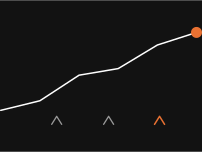
100%
physician compliance in less than one quarter
35%
increase in cash flow
Bi-weekly
physician query reports
Case study
5 min read
TL;DR
- Provider: One of the largest hospitals in the Midwest.
- Challenge: Improper clinical documentation, high-impact diagnosis-related group discrepancies, inconsistent physician notes, missed diagnoses, multi-million-dollar leakage, and physician education gaps.
- Solution: A clinical documentation improvement program with documentation-process analysis, customizable provider education, certified MD-led training, physician query tracking, and bi-weekly executive reporting.
- Impact: 100% physician compliance in less than one quarter, 35% increase in cash flow, fewer queries, improved productivity, increased reimbursement, and reduced revenue leakage.
One of the largest hospitals in the Midwest was experiencing major revenue loss caused by improper clinical documentation. Documentation discrepancies involving high-impact diagnosis-related groups, or DRGs, created multi-million-dollar leakage and weakened the connection between physician notes, medical coding, and claims accuracy.
The provider needed a CDI operating response that could improve documentation behavior, reduce coding queries, and protect reimbursement and compliance. We applied a customizable provider education program, certified MD-led training, documentation analysis, and bi-weekly reporting so leaders could see progress in physician engagement and revenue cycle outcomes.
The Challenge
The provider faced a documentation integrity problem with direct revenue cycle and compliance consequences. Physicians had not been properly trained on how accurate documentation affects revenue, coding, and claims. That gap led to inconsistent physician notes, missed diagnoses, and documentation discrepancies affecting high-impact DRGs.
The existing approach could not absorb the problem because the issue sat upstream of coding. Medical coders lacked crucial information when physician documentation was incomplete, which reduced reimbursement rates and increased compliance risk. The provider needed physician engagement, focused education, query tracking, and executive visibility rather than a downstream coding-only fix.
The Solution
Physician-focused CDI education with query and productivity governance
We treated CDI as a physician engagement and documentation behavior problem connected to revenue integrity. The approach was anchored in four mechanisms:
- Documentation-process analysis: Performed a comprehensive review of the hospital documentation process to identify improvement areas, including physician query volume, productivity rates, and documentation consistency.
- Certified MD-led provider education: Used certified MDs to work with physicians on CDI best practices, documentation strategies, accurate coding support, claims impact, patient care quality, and compliance risk.
- Query tracking and physician feedback: Implemented bi-weekly physician reports tracking the number of coding queries generated, using fewer queries as a signal of more complete and compliant documentation.
- Executive KPI reporting: Provided bi-weekly reports to hospital executives showing improved productivity, increased reimbursement, reduced revenue leakage, and CDI program performance.
The Impact
- 100% physician compliance was achieved in less than one quarter after the CDI education and reporting program improved participation and documentation discipline.
- Cash flow increased by 35% after proper documentation practices reduced missed information and supported more accurate coding and claims.
- Physician query volume decreased as providers supplied more complete and compliant documentation, giving medical coders better information for claims.
- No high-impact DRGs, SOIs, or ROMs were recorded incorrectly.
Why Us
The provider needed CDI expertise that could address documentation, physician behavior, compliance, and revenue cycle impact together. Our team had corrected similar issues at health systems across the country and used a customizable provider education program supported by certified MDs, reporting cadence, and KPI tracking.
Transferable Insights
For CFOs, Chief Revenue Cycle Officers, HIM, coding, CDI, and mid-cycle leaders, the practical lesson is that documentation improvement requires physician behavior change. CDI programs gain traction when leaders analyze query patterns, teach documentation impact in clinical terms, reinforce compliance, and report progress with physician-level and executive-level visibility.
Frequently Asked Questions
What revenue cycle problem did the Midwest hospital need to solve?

Why did physician documentation affect cash flow?
What did the CDI program include?
What measurable results did the CDI case study achieve?
How did the team measure physician documentation improvement?
How did the CDI program reduce compliance and revenue leakage risk?
Which leaders should review this CDI case study?

Extend performance across connected outcomes.


Revenue cycle thinking for leaders who need fewer surprises.
Explore Vee Healthtek perspectives on the forces reshaping revenue cycle performance, healthcare operations, technology adoption, and financial resilience.


Ready to connect physician documentation with cash-flow confidence?
Bring a physician query report, CDI audit summary, DRG discrepancy sample, or documentation completeness dashboard to a focused conversation. We can discuss where documentation gaps appear, how education should work, and which reporting cadence may help improve compliance and revenue integrity.