
Strengthen revenue integrity. Make every claim accurate, complete, and defensible.
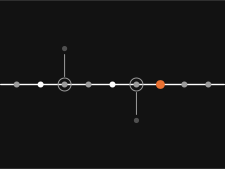
Revenue integrity connects the care delivered, the clinical record, the coded data, the charge, the claim, and the payment. When those records do not agree, hospitals and health systems face missed revenue, rework, denials, underpayments, compliance exposure, and unreliable reporting. We align front-office, mid-office, and back-office controls so each claim reflects supported care and withstands payer review.
32M+
Coding charts processed annually
80%
Appeal success Rate
7 of top 20
U.S. health systems served
Build revenue integrity into the work, not around the exceptions.
Healthcare revenue integrity means the clinical record, code set, charge description, claim, contract expectation, and remittance tell the same financial story. Breaks between these functions create missed or unsupported charges, coding variance, edits, denials, underpayments, credit balances, and audit risk. We connect the people and controls across the cycle, then trace recurring defects to the workflow where they begin.
Align care, documentation, coding, and charges
Submit claims that are accurate and defensible
Make recurring defects visible and accountable
Four controls strengthen revenue integrity across the cycle.
Revenue integrity depends on accurate inputs, complete clinical and charge capture, compliant claims, and payment validation. These four service levers connect the clinical, operational, and financial record so hospitals, health systems, physician enterprises, and ambulatory networks can protect reimbursement and reduce downstream rework.
Protect accurate inputs
- Registration QA and Demographic Accuracy
- Eligibility and Benefits Verification
- Prior Authorization
- Health Information Management Support
Align documentation, coding, and charges
- Clinical Documentation Integrity (CDI)
- Medical Coding
- Coding Audits and Quality Assurance
- Charge Capture Optimization
Validate compliance before billing
- Revenue Integrity and Leakage Prevention
- Billing Compliance and Audit Defense
- Claims Editing and Clean-Claim Validation
- Claim Submission and Clearinghouse Support
Reconcile payment and variance
- Payment Posting and Reconciliation
- Denials Management and Appeals
- Underpayment Recovery and Payer Variance Resolution
- Credit Balance Review
Align the record, protect the claim, validate the payment, correct the source.
Accurate patient and payer data
Validate registration, coverage, authorization, and health information inputs so the account reaches coding and billing with fewer preventable defects.
Defensible documentation, coding, and charges
Reconcile the clinical record, coded data, and charges so each billed service is complete, accurate, supported, and compliant.
Clean claims and accurate reimbursement
Apply claim controls before submission, post remittance correctly, and investigate denials, underpayments, and credit balances against the expected result.
Closed-loop integrity improvement
Trace recurring defects to the originating workflow, assign corrective action, and verify whether the control holds across facilities, specialties, and payers.
One operating model. Three pillars. Every engagement.
Practitioner-led
Specialists who understand the clinical, coding, charge, claim, compliance, and payment dependencies behind revenue integrity.
- Coding, CDI, revenue integrity, billing compliance, denials, and reimbursement practitioners
- Payer, specialty, and care-setting expertise aligned to the work
- A named engagement lead who connects operational defects to financial and compliance risk
Technology-powered
Workflow intelligence that validates records, surfaces variance, and directs attention to the exceptions that matter.
- Rules that compare documentation, coding, charges, claims, and remittance
- Worklists organized by defect type, financial significance, filing risk, and recurrence
- Dashboards connecting integrity findings, owners, corrective action, and validation
Operationally-governed
Open Accountability that makes definitions, findings, ownership, and corrective action visible.
- Governance reviews tied to agreed revenue integrity KPIs
- Quality audits that show where controls hold and where they fail
- Closed-loop corrective action that feeds findings back to source workflows
Our Vision
Open accountability: Taking responsibility without taking control.
Revenue integrity should not sit inside a black-box audit or one-time recovery project. You retain visibility into definitions, source data, audit findings, financial exposure, owners, corrective actions, and validation. We align measures with your teams and use recurring defects to strengthen First-Pass Performance across the cycle.
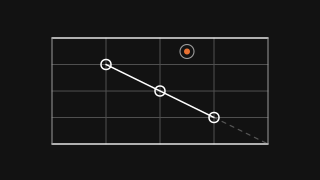
Charge Capture Accuracy
Supported services recorded and billed without omission, duplication, or unsupported value
Coding Accuracy
Codes supported by the clinical record and applicable coding requirements
Clean-Claim Rate
Claims accepted on first submission without preventable edits or rework
Preventable Denial Rate
Denials linked to defects that could have been corrected before submission
Payment Variance Resolution
Validated differences between expected and received reimbursement resolved
Why Us
What sets our revenue integrity practice apart.
Retrospective cleanup finds defects after claims, payments, and reporting have already been affected. First-Pass Performance aligns documentation, coding, charges, claims, and remittance earlier, then keeps corrective action visible until the defect stops recurring.
Rework-Powered Cleanup Machine
Our First-Pass Performance
Charge protection
Missed or incorrect charges are found through periodic cleanup.
Documentation, coding, and charge reconciliation happen before claim release.
Denial response
Teams appeal individual denials after time and value are already at risk.
Recurring denial causes are used to strengthen upstream controls, edits, and accountability.
Leakage visibility
Loss becomes visible only after denials, write-offs, or month-end variance.
Risk is identified at the workflow or handoff where it enters.
Payment accuracy
Payment is accepted unless a team identifies the variance later.
Expected reimbursement is compared with remittance, and shortfalls are routed for action.
Governance
Departments report activity, but financial ownership remains fragmented.
One view connects the source, dollars at risk, owner, corrective action, and validation.
Revenue cycle thinking for leaders who need fewer surprises.
Explore Vee Healthtek perspectives on the forces reshaping revenue cycle performance, healthcare operations, technology adoption, and financial resilience.
OBBBA And Revenue Cycle Management: 2027 CFO Guide

The Revenue Cycle Rework Trap

Hospital Price Transparency in 2026
Run one code set through a two-way accuracy check.
Schedule a 30-minute working session with our integrity review practice. Pick one code set or department and share recent claims with their documentation. We will sample for support in both directions, show what an auditor would flag and what a payer underpaid, and leave the findings with you, both directions included.
Frequently Asked Questions
What does healthcare revenue cycle transformation include?

How is revenue cycle transformation different from outsourcing one function?
Where should hospitals and health systems begin revenue cycle transformation?
Can revenue cycle transformation work with our current technology and teams?
How do you measure revenue cycle transformation?
We've been through failed transformations. Why would this one stick?
Do we have to replace our EHR or billing systems to modernize?
Where does a full revenue cycle rebuild usually start?
How long before results show, and how are they measured?
What happens when the engagement ends?