
End-to-End RCM or Point Solutions
A practical guide to choosing the right RCM model.
September 10, 2026
Blog
8 min read

TL;DR
- Choose point-solutionoutsourcing when the problem is truly isolated, measurable and operationallycontained.
- Choose end-to-end RCMoutsourcing when performance gaps cross functions and require coordinatedownership across the revenue cycle.
- The strongest option may be amodular partner with end-to-end capability, allowing you to start focused andexpand based on evidence.
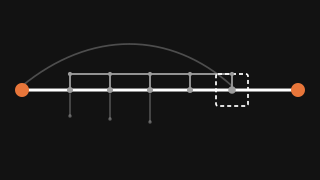
Start with the revenue cycle problem. | Start With The Problem
The choice between end-to-end Revenue Cycle Management (RCM) outsourcing and point-solution outsourcing is not simply a choice between a large engagement and a small one. It is a decision about where the problem begins, how far its consequences travel and who should be accountable for fixing it. A healthcare provider may see a coding backlog, rising authorization delays or growing denials. Yet the visible issue may be only the final expression of an upstream workflow failure, incomplete documentation, inconsistent payer rules or a technology configuration gap. The right model should address the source of performance loss, not merely create more capacity at the point where the loss appears.
Begin by distinguishing an isolated capacity problem from a connected operating problem. Point-solution outsourcing can work well when scope is clear, inputs are reliable and success can be measured within one function. Coding overflow, a defined accounts receivable inventory or authorization support for a specific specialty may fit this model. It can add expertise quickly without transferring broad control. However, a narrow solution becomes less effective when its output depends on unresolved failures elsewhere. More coders will not eliminate missing clinical documentation. More denial specialists may recover cash without preventing the registration, authorization or coding errors that caused the denial.
Compare end-to-end RCM and point solutions. | Compare Outsourcing Models
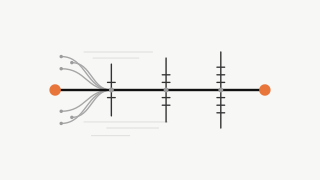
End-to-end RCM outsourcing is more relevant when performance varies across multiple stages, internal leadership lacks capacity to coordinate improvement or fragmented ownership prevents sustained change. One partner can connect patient access, health information management, billing, denials, follow-up and patient financial services around shared outcomes. This can reduce vendor boundaries and make dependencies easier to manage. It also creates a larger transition, so the organization needs a credible implementation plan, clear decision rights and safeguards for cash, employees, compliance and patient experience.
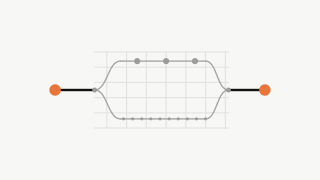
In practice, the choice does not need to be binary. An ideal partner can bring end-to-end capability while allowing the relationship to begin with a focused module. That combination matters because a partner supporting only coding should still understand how documentation, charge capture, edits, billing and denials influence coding performance. Likewise, a prior authorization engagement should consider scheduling, medical necessity, payer requirements and patient communication. The service remains focused, but the diagnosis is not isolated.
Use these criteria tocompare RCM outsourcing models.
Evaluate cost, risk and operating impact. | Evaluate Operating Impact
The financial comparison should go beyond unit price or vendor fees. Model the total cost of management, integration, technology, transition, retained staff and duplicated work. A point solution can look inexpensive while leaving internal teams responsible for coordinating handoffs and correcting defects outside the vendor’s scope. An end-to-end arrangement can consolidate expense but create concentration and transition risk. Compare expected impact on cash, days in A/R, denial rates, cost to collect, authorization turnaround, coding quality, clean claims and patient balances. Baseline definitions should be agreed before contracting so performance gains are measurable rather than interpretive.
First-pass performance is a useful lens because it asks whether work is completed correctly the first time and can move forward without avoidable correction. Rework consumes capacity, delays billing and often hides inside departmental productivity metrics. A coding team may meet throughput targets while claims return for documentation clarification or edits. A denial team may increase overturns while preventable denials continue entering the inventory. Ask each prospective partner how it identifies where rework originates, quantifies its cost and prevents recurrence across organizational boundaries.
Technology should support the operating model rather than dictate it. Determine whether the partner can use and optimize native EHR capabilities before adding another platform. For each proposed tool, ask what gap it fills, what data it requires, who owns configuration, how performance will be monitored and what happens when the relationship ends. Point solutions can provide specialized functionality quickly, but multiple tools can fragment work queues and reporting. End-to-end partners may offer an integrated platform, but the healthcare provider should test interoperability, data access and dependence on proprietary infrastructure.
Choose a partner, not only a scope. | Choose The Right Partner
Governance requirements do not disappear with outsourcing. They change. Define who owns outcomes, who resolves cross-functional issues, which decisions remain with the healthcare provider and how corrective action will be managed. Open accountability means the partner makes performance, causes, dependencies and actions visible rather than protecting itself behind the limits of a statement of work. Dashboards should connect operating measures to financial outcomes. Reviews should distinguish temporary recovery from sustainable prevention, and service levels should include quality, responsiveness and patient impact, not only production volume.
The decision should also account for people and organizational knowledge. Identify roles that must remain internal to govern payer strategy, compliance, clinical alignment, financial policy and enterprise priorities. If employees transition to a partner, evaluate communication, continuity, leadership access and retention plans. If only a point solution is outsourced, define the handoffs between internal and external teams in operational detail. Ambiguity at these seams is a common source of duplicated work and delayed resolution.
A practical selection process starts with a diagnostic, not a preferred delivery model. Map the problem across upstream and downstream dependencies, establish a baseline, quantify rework and identify the capabilities required to improve the result. Then assess whether the organization needs a specialist, an enterprise operator or a modular partner capable of both. The best model is the one that matches present readiness without limiting future options. It should generate evidence early, protect operational continuity and earn a broader role through measurable performance.

Frequently Asked Questions
What is end-to-end RCM outsourcing?

What is a point solution in revenue cycle management?
Is end-to-end RCM outsourcing better than point solutions?
How should a healthcare provider choose an RCM outsourcing model?
Can a healthcare provider start with one service and expand later?
Which metrics should RCM outsourcing contracts include?
Extend performance across connected outcomes.
Revenue cycle thinking for leaders who need fewer surprises.
Explore Vee Healthtek perspectives on the forces reshaping revenue cycle performance, healthcare operations, technology adoption, and financial resilience.

Buildan RCM model around your priorities.
Find theright RCM model for your operation. Complete the form to discuss your revenuecycle priorities and explore a modular approach that can begin with one needand expand as results and readiness grow.
Continue exploring expert perspectives, industry trends, and practical strategies for improving revenue cycle performance.
Explore Points Of View